
Enough Is Enough, Really
On hot showers, fire-baked bread, and the quiet rebellion of needing less

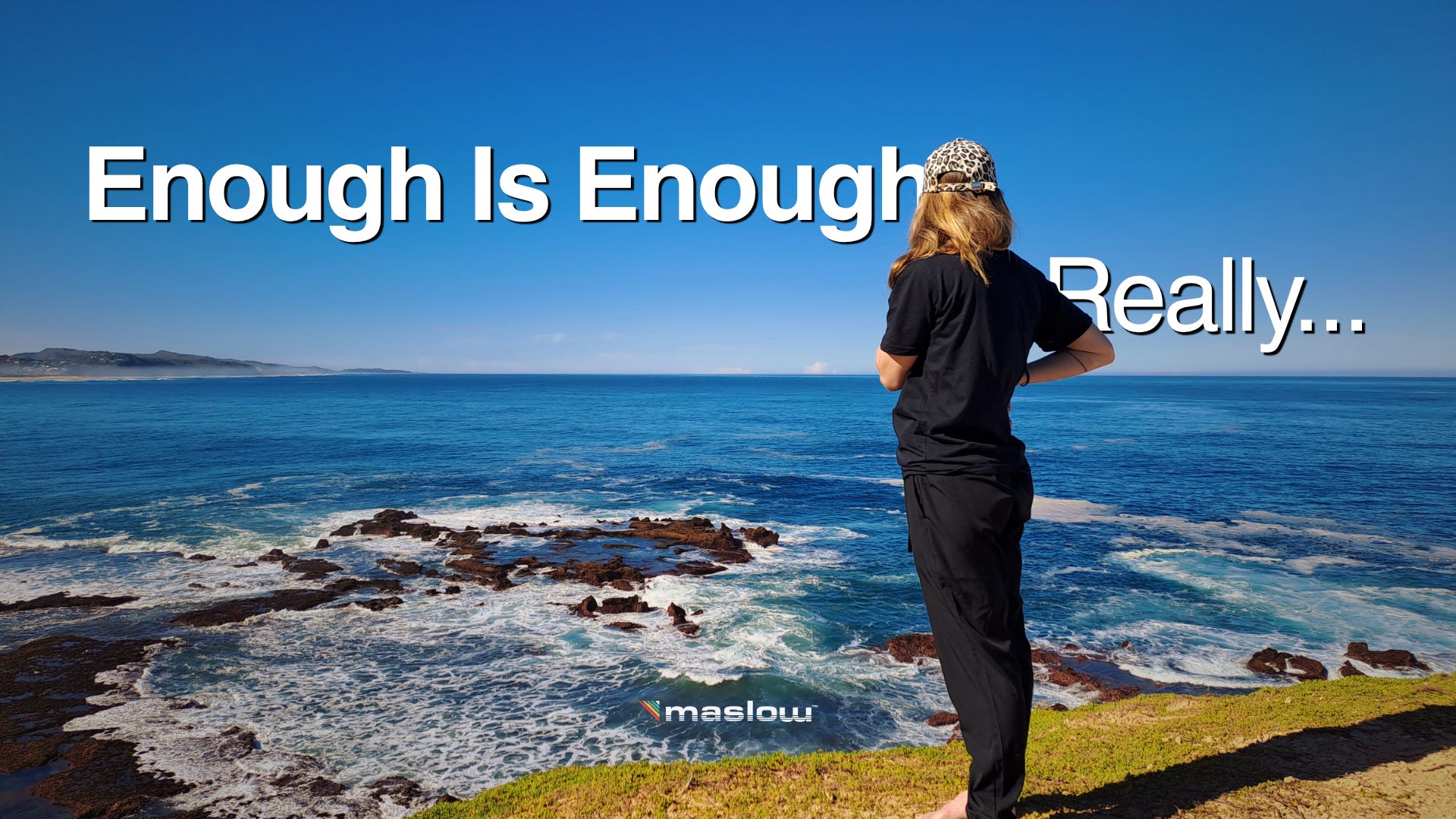
The deep comfort that comes only after being deeply uncomfortable, is hard to even understand unless you’ve felt it firsthand.. This last month was marked by cold feet, smokey hair, children running barefoot through the forest and the sudden, almost cathartic experience of hot water after a few winter nights spent camping.
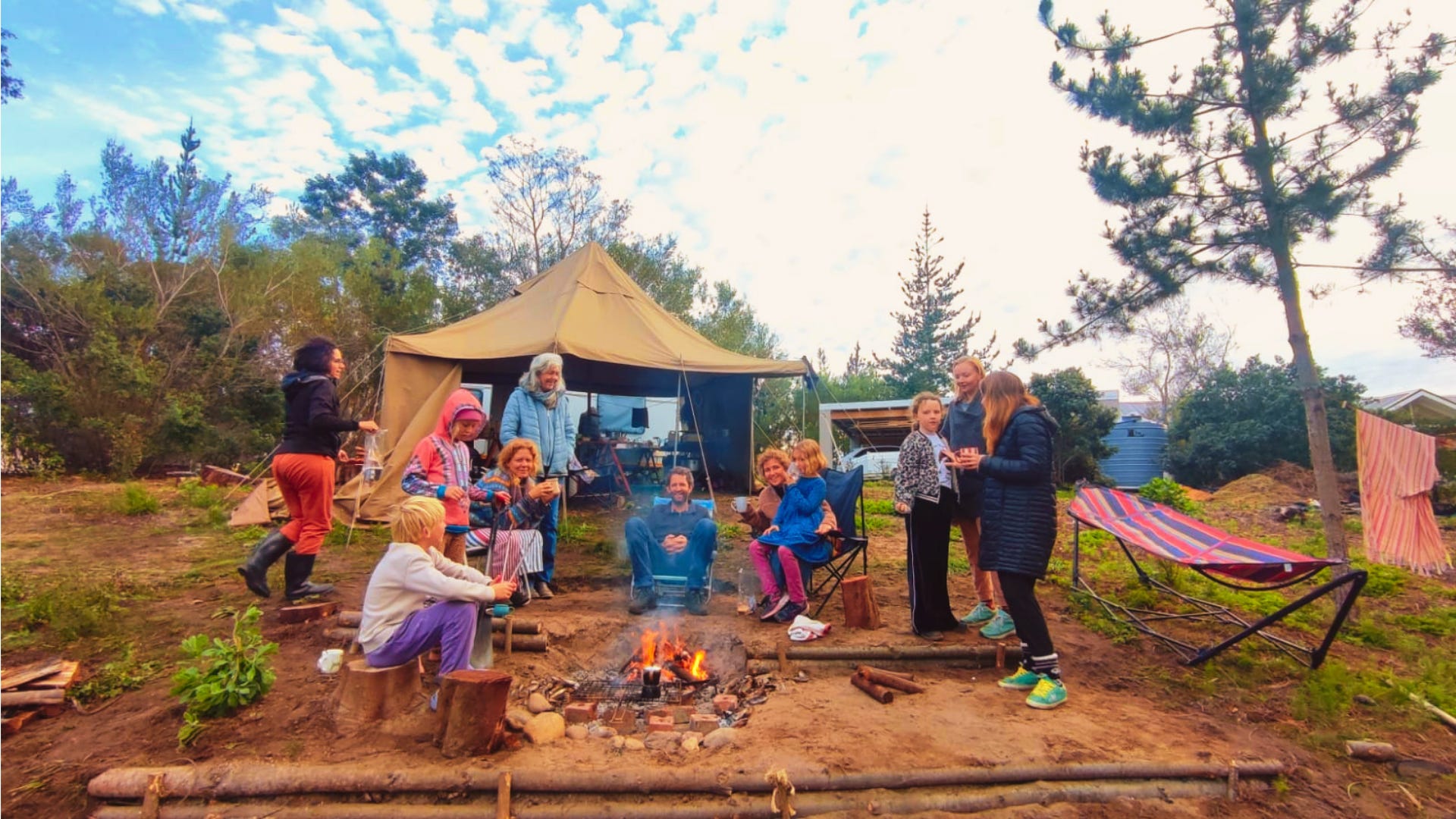
It was school holidays, and I had the privilege of taking a road trip along South Africa’s beautiful Garden Route with my daughter and my friend Dani. We camped with the most wonderful group of people on a farm just outside Sedgefield, where, for a little while, life became wonderfully raw and uncomplicated. Our days were arranged around wood fires, shared meals, children, weather and light. At night the sky was crowded with stars, and in the mornings we woke carrying the scent of smoke in our clothes and the strange, wild softness that comes when life has been unplugged from most of its usual business and technologies.
And the thought that kept returning to me, again and again, was this:
We really don’t need very much, do we?
Not in the tired, minimalist, throw-away-half-your-cupboards kind of way. Not as another lifestyle aspiration to perform online. I mean it in the deeply physical sense that, when life becomes simpler, your body begins to remember what enough actually feels like.
When you are camping in winter and get to stand under a hot shower, that is absolute abundance. When the shops are far away and someone pulls a loaf of fresh, fire-baked bread from the coals, that is abundance. When the children find other children to disappear into play with, and you get to sit in a patch of winter sun with multiple cups of tea and have a deep, wandering, uninterrupted conversation with a friend, that is abundance too.
And when everyone places their slightly random collection of ingredients, skills, time, tools and energy in the middle, somehow there is more than enough.
Not because anyone brought everything. Because everyone brought something.


The Kind of Gratitude You Cannot Manufacture
We have heard a lot about gratitude. We have been told to write lists, keep journals, think positive thoughts and remind ourselves that somebody somewhere probably has it worse. And perhaps all of that has its place. But the gratitude I am speaking about is not polite, performative or particularly well behaved.
It is raw, almost primal.
It is the gratitude that rises unexpectedly when your whole being recognizes that it is being held by something larger than itself. It is not an idea you impose upon the mind but rather a response from the body.
The hot water does not feel miraculous because you have successfully reframed your thinking. It feels miraculous because you were cold, and now you are warm. The bread tastes extraordinary because you have been tending the fire and waiting together. The conversation feels like medicine because somebody is really there with you, listening, while the children are safely absorbed in a world of their own.
This kind of gratitude emerges through relationship. It comes when you feel yourself as part of the whole rather than a small, exhausted individual trying to extract what you need from it.
Connected is the important word here.
Only when we experience ourselves as part of the living system can we begin to appreciate all the visible and invisible ways that system is supporting us. The hands that kneaded the dough. The tree that became the firewood. The soil that grew the grain. The person keeping an eye on the children. The friend who remembered the tea. The river, the rain, the insects, the microbes and the million small acts of life quietly making our lives possible.
Perhaps the more useful question is not only, What can I get from this?
Perhaps it is also, What can I bring? What can I tend? What can I give? To make this moment more wonderful for all of us.
Wealth Is What Can Move Between Us
This brought me back to the idea of the gift economy, something AfrikaBurn has understood rather beautifully. A gift economy is not simply a world where everything is free. It is a world in which value is allowed to move through relationships instead of being trapped exclusively inside transactions.
One person brings bread. Another knows how to start a fire. Someone has extra blankets. Someone else watches the children. Someone listens when your heart is heavy. Someone lends the knife, boils the water, washes the pot, tells the ridiculous story or notices that you have gone quiet.
Nobody keeps perfect score, but somehow, because the giving keeps circulating, everybody becomes wealthier.
It reminded me that perhaps wealth is not only what we can accumulate, insure, lock away or prove that we own. Perhaps wealth is also what we can access through trust. What we can borrow without shame. What we can offer without depletion. What we can grow, share and steward together.
The less isolated we are, the less each person has to possess individually.
When we all live in separate little bubbles, every household needs its own version of everything: its own tools, appliances, vehicles, childcare solutions, entertainment systems, emergency plans and private stores of backup resources.
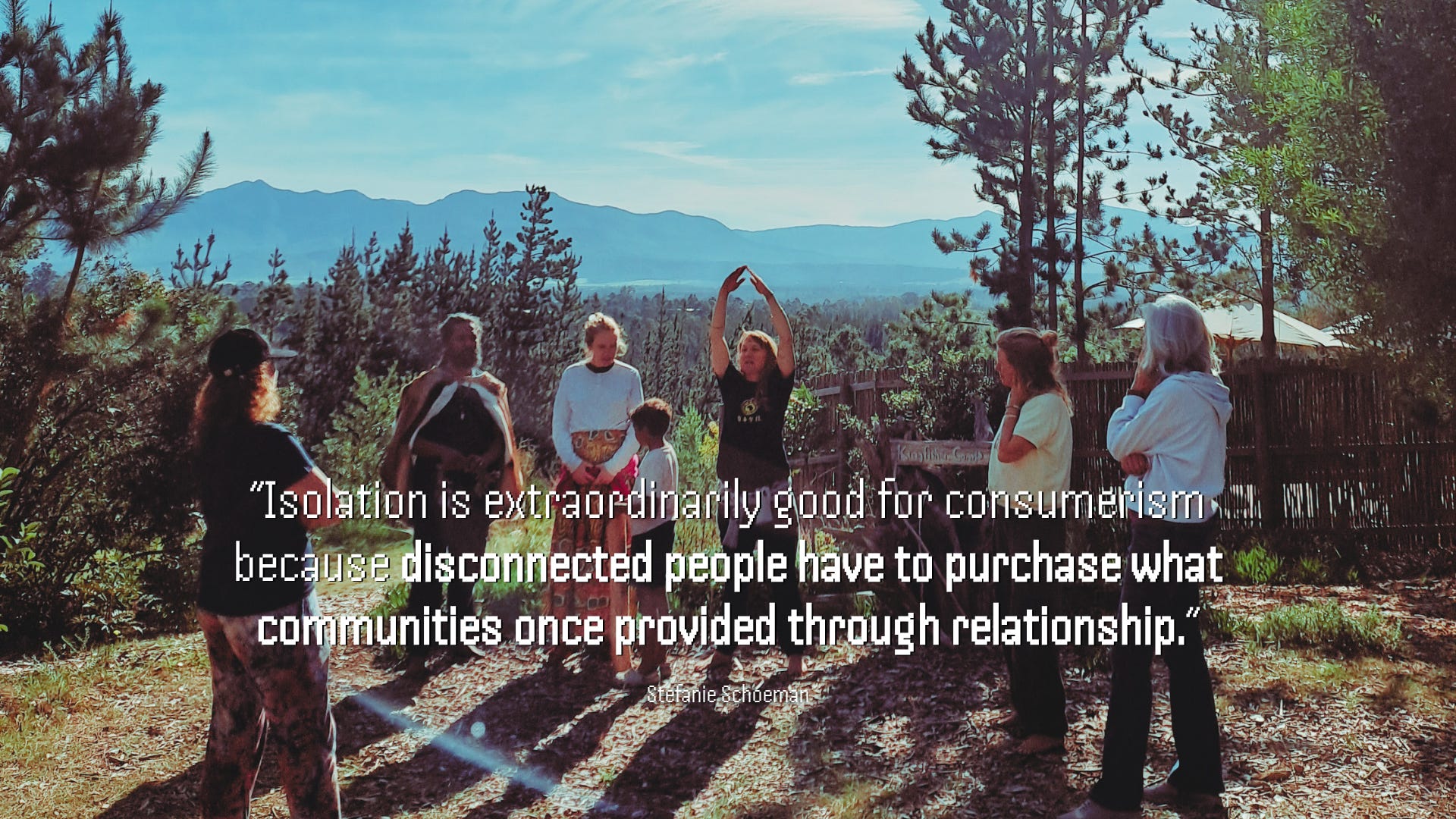
Isolation is extraordinarily good for consumerism because disconnected people have to purchase what communities once provided through relationship.
And so the boilers keep burning.
We keep earning more to buy ourselves tiny fragments of the support we are missing. We buy convenience because we have run out of time. We outsource care because we have run out of capacity. We hand our children to digital caretakers that can occupy their attention but cannot genuinely care for them. We try to do the work of an entire village within the walls of a single household: keep the money flowing, the clothes clean, the pantry stocked, the messages answered, the children regulated, the appearances acceptable and the wheels turning.
Alone.
The nuclear family, when expected to carry all of this in private, begins to feel less like a cosy social unit and more like a quietly ticking timebomb. Not because families are failing, but because the container is simply too small for everything we have asked it to hold.
And my darling, we were never meant to do this alone.
Community Is Not Something We Can Preach Into Existence
Of course, we have said this before. We talk about community on this platform and throughout the Maslow universe all the time. We talk about living systems, collaboration, shared resources and the more beautiful world our hearts know is possible.
But how do we actually get there?
Because community is not created by putting the word on a website. It cannot be manifested through a mood board or summoned by repeatedly explaining how much we need it.
Community is built through consistency and over time.
My mother reminded me of this recently when we were speaking about my dad and his remarkable ability to maintain more genuine friendships than most people could comfortably keep track of. He seems to have relationships everywhere: real relationships, built across years, distance, life stages and changing circumstances.
My mother said she thinks it is because he takes the time; he listens, remembers and reaches out. He follows up and he puts effort into being a friend.
Yes, he is retired now, and not all of us have the same time or capacity. But perhaps friendship does not always require the hours we imagine it does. Sometimes it requires a moment of undivided attention. A message sent when someone crosses your mind. A question asked with enough sincerity that you stay present for the answer. The willingness to remember what a person told you last week and ask about it again.
“If you want a friend, be a friend.”
Simple, obvious and much harder to practice than it sounds.
Because consistency is not glamorous. It does not usually arrive as a grand gesture. It is the meal delivered quietly. The birthday remembered. The voice note answered. The apology made without being dragged out of someone. The feedback listened to instead of defended against. The small promises kept. The willingness to return after misunderstanding and repair what became frayed.
Community is made from thousands of these tiny relational stitches. And I big part of me believes that this is the lesson of our time; How to Relate to Each Other Again 101 (coming soon to neighborhood near you!)
An Ecosystem of Care
Recently, I found myself in a difficult place, and members of our Maslow team showed me a level of care and concern that made all the difference to my ability to carry on.
Nothing about the situation changed instantly. The work was still there. The complexity did not evaporate. But I was no longer carrying it in quite the same way because someone else had noticed. Someone had paused long enough to see me, and their presence altered the weight of what I was holding.
It made me realize that consistency is not only about what we do. It is also about the quality of being we bring to what we do.
You cannot fake genuine kindness for very long. You cannot manufacture real care through the right language. Just like you cannot pretend to feel that you have enough if there is no deeper relationship with gratitude inside of you.
People feel the difference. You feel the difference.
We can feel when somebody is waiting for their turn to speak and when they are actually listening. We can feel when care is a performance and when it is embodied. We can feel when an organisation’s values live only in a document and when they have travelled all the way into its meetings, decisions, messages, budgets and everyday human interactions.
This month, we have also had the privilege of working with SOS Africa and Greenpop, witnessing first-hand how people with beautiful hearts and genuine care for living things operate in the world. What stands out is not only the work itself, but the ecosystems that make the work possible.
There may be extraordinary champions in particular areas, people whose courage and devotion move entire projects forward. But none of them are doing it alone. Their impact is made possible by relationships, teams, donors, volunteers, educators, communities, administrators, growers, organisers and countless other people attending to the small pieces that hold the larger vision together.
This is what an ecosystem of care looks like.
It does not depend on one heroic person carrying everything. It works because many different forms of contribution are allowed to belong.
The Work That Holds the World Together
I keep thinking about the invisible labour traditionally carried by mothers: the million micro-moments of remembering things outside of themselves. Food, dishes, washing, appointments, school projects, birthdays, moods, medicine, missing shoes, forms that need signing, snacks that need packing and the hug required at precisely the moment there is supposedly no time for one.
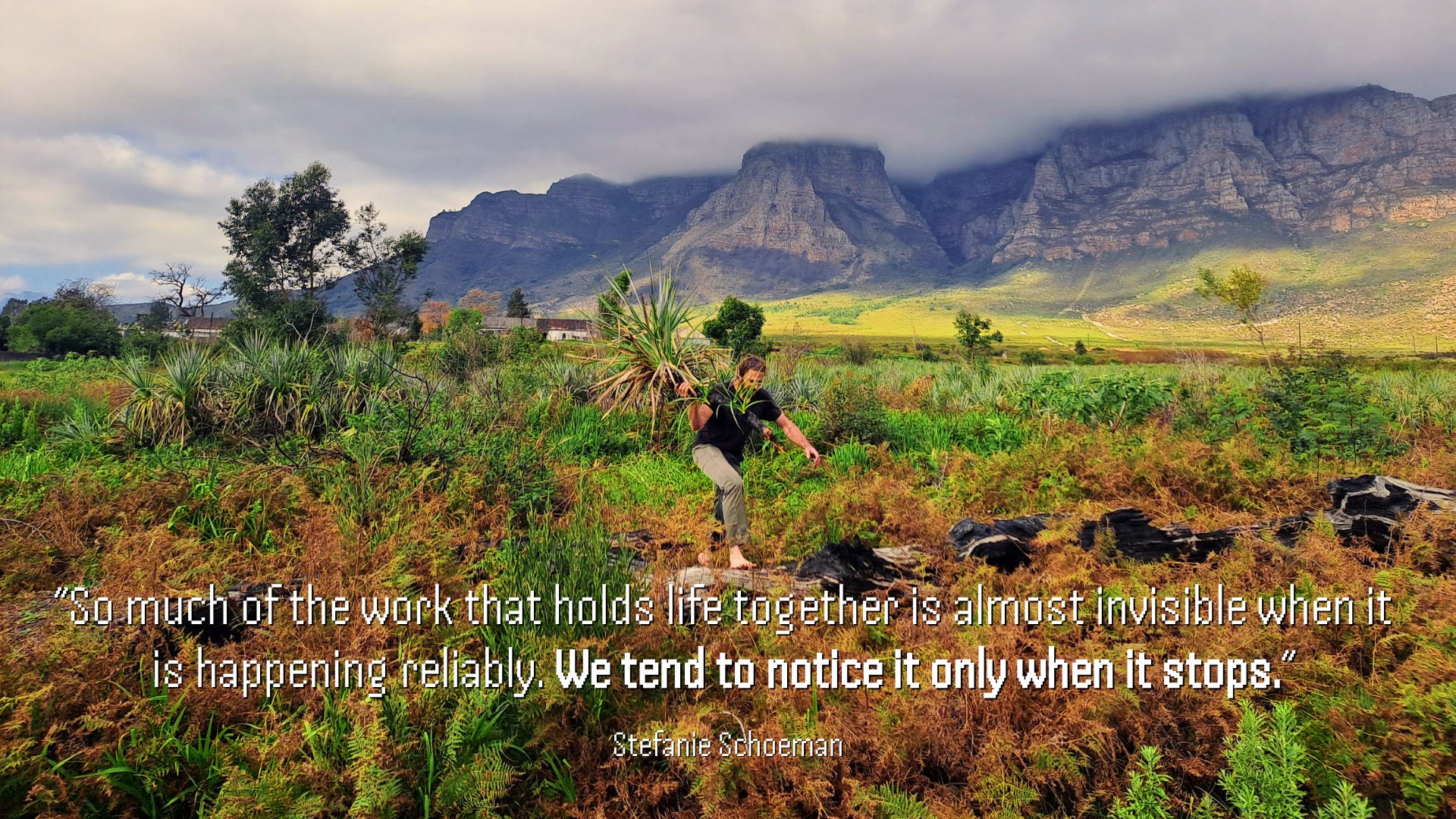
So much of the work that holds life together is almost invisible when it is happening reliably. We tend to notice it only when it stops.
Nature works like this too.
Healthy living systems are constantly performing countless acts of care that we rarely witness directly. Water is filtered. Soil is built. Dead matter becomes nourishment. Roots hold landscapes together. Fungi carry messages and nutrients beneath our feet. Flowers become fruit because something small and winged moved between them at the right moment.
No single part is doing everything and each part participates, and life emerges through the relationships between them.
Perhaps this is what we have forgotten. We have been trained to notice individual achievement more easily than interdependence, the fruit more easily than the whole network of soil, water, insects, roots and human hands that made the fruit possible.
But gratitude deepens when our perception widens.
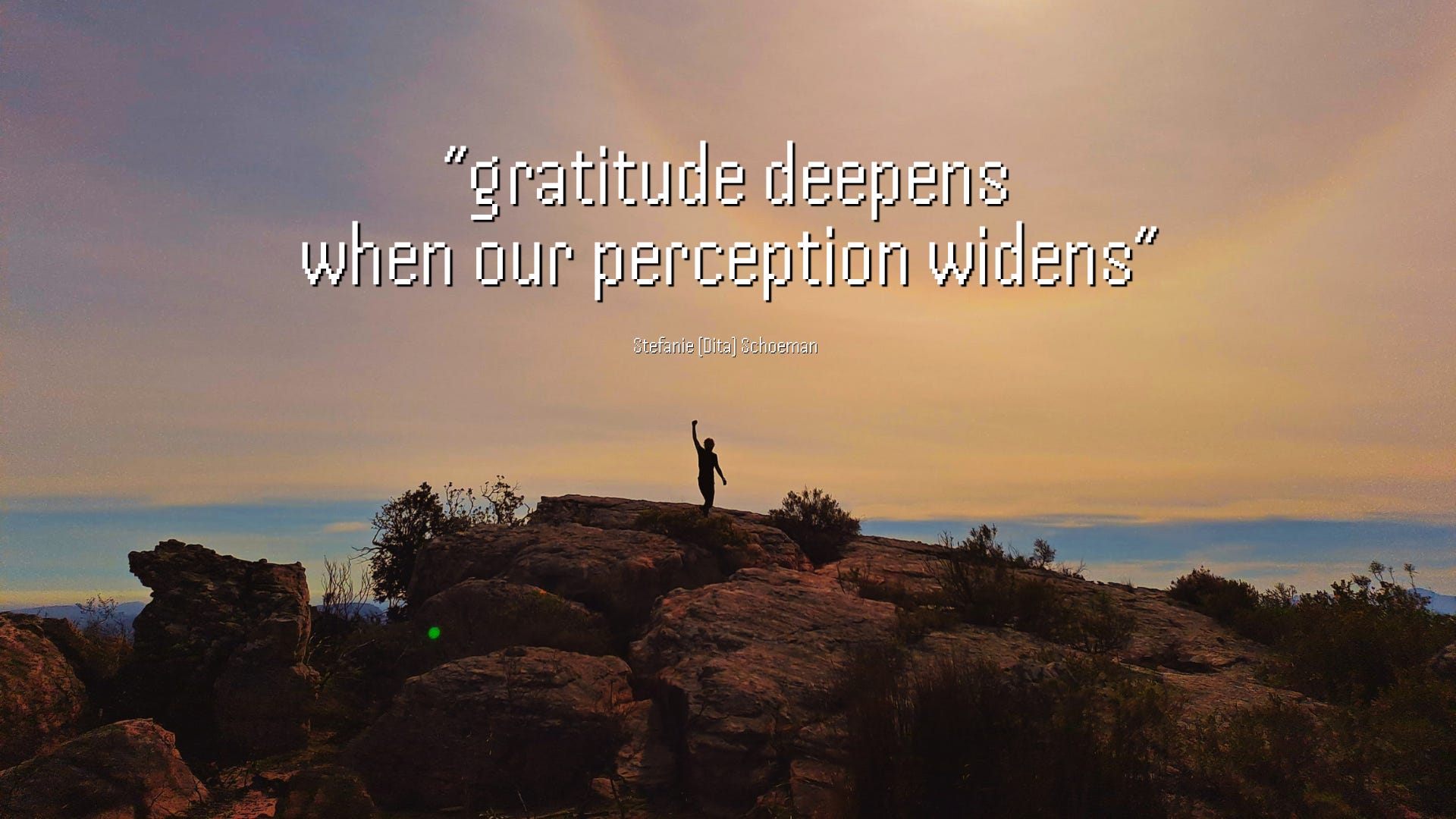
The more of the system we can see, the more there is to be grateful for. And the more grateful we become, the more naturally we want to participate in caring for the whole. Not because somebody frightened or shamed us into responsibility.
Because we have fallen back into relationship.
Enough Is Enough
Perhaps “enough is enough” is both a declaration and a prayer.
Enough of the isolation that keeps convincing us we must own, manage and survive everything alone. Enough of performing values we are not practicing. Enough of grand gestures that cannot be sustained. Enough of confusing abundance with accumulation and independence with freedom.
But also:
There is enough.
There is enough when we remember how to share. There is enough when we stop requiring one person to be the entire village. There is enough when resources are allowed to circulate, when care becomes consistent, and when we measure wealth not only by what is stored but by what is available through relationship.
Enough does not mean giving up on beauty, growth or possibility. It does not mean accepting deprivation or pretending that injustice is somehow spiritual. Enough is the point at which the frantic reaching can soften, allowing us to see what is already here and ask how we might tend it.
It is the point at which gratitude becomes action.
Maybe the more beautiful world our hearts know is possible will not arrive through one spectacular breakthrough. Maybe it is already being assembled through ordinary acts repeated until they become culture: bread broken, children watched together, fires tended, messages answered, conversations continued, feedback received, soil restored, trees planted and people noticing when someone else is struggling to carry the load.
Perhaps our task this month is simply to look around and ask:
What is already holding me?
Who might need to know that I am here?
What am I carrying that could be shared?
And what small act of care am I willing to repeat consistently enough that someone else can begin to trust it?
May you remember what enough feels like. May you notice the vast web of life quietly supporting you. May you find the courage to reach beyond the walls of your own little bubble!
And may we become, through a thousand small and faithful acts, the ecosystem of care we have been waiting for.
With love, gratitude and the lingering smell of freshly baked bread,
The Maslow Initiative 🌿
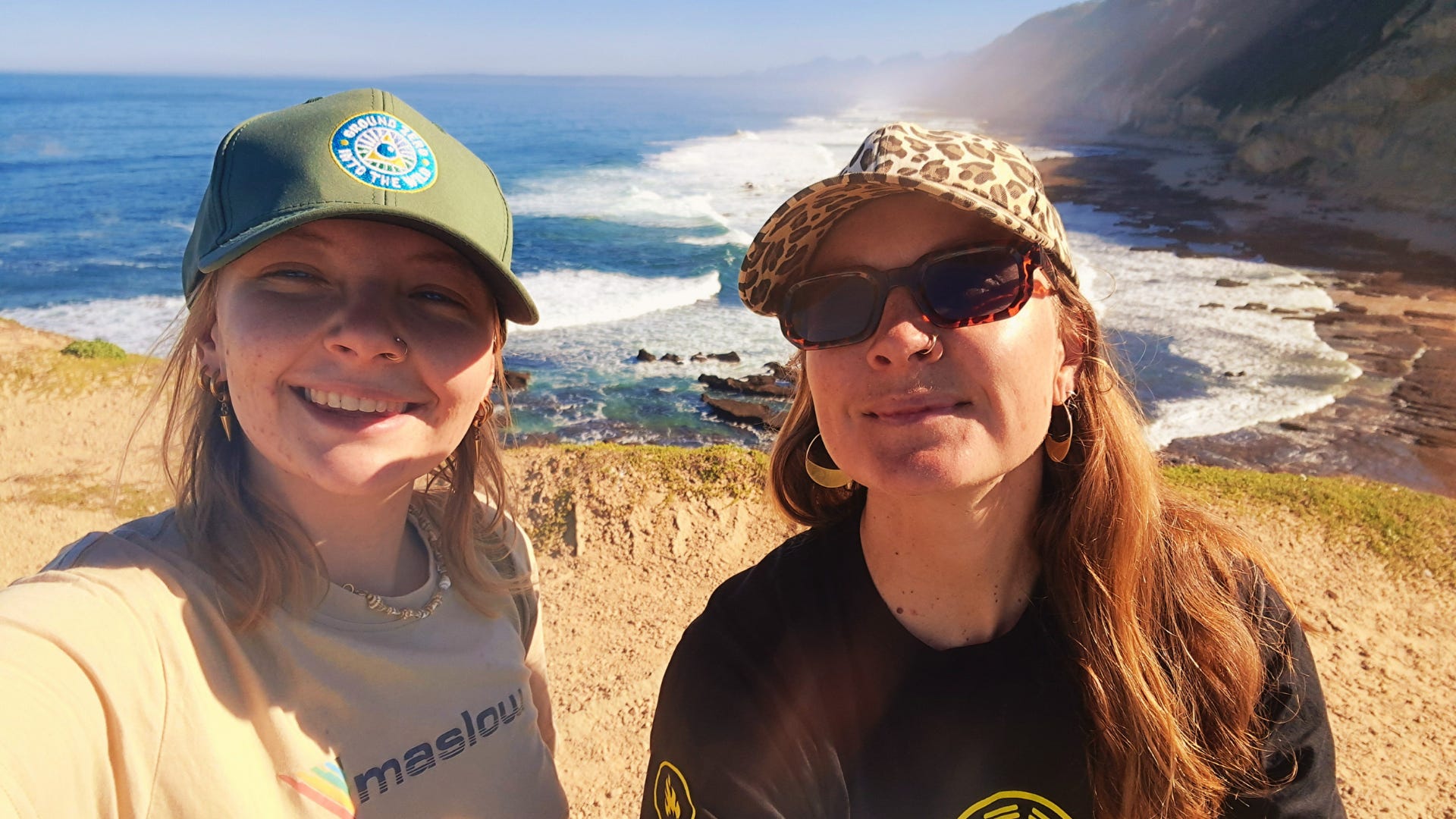
Tending the things we already have can also be a discovery that those things have vallue and are worth tending and sharing.
Thank you, as always for making me pause to appreciate 🫰🏻